


The restoration of the paintings
The Alajmo brothers, together with French designer Philippe Starck, entrusted the project management to architect and former rector of the IUAV University, Marino Folin, who coordinated the best Venetian craftsmen under the supervision of the Superintendency of Venice.
The key underlying the entire operation is the phenomenon of high water, to which the Alajmo brothers have chosen to give a central role. The water, with its passage, leaves its marks and thus becomes an active and living part of the history of the venue.
Valese Foundry
For the table legs, the reception desk, and all surfaces in contact with the ground floor, natural, unpainted brass was chosen. This material is deliberately exposed to the effects of high water: as it oxidizes over time, its color variations will become a visible map of the tides, layering the mark of each event on the surface.
The brass sign, made by Fonderia Valese, summarizes this concept in a single image: the lower part is already oxidized, evoking the ground floor, perpetually subject to high water; the upper part is polished, representing the restaurant on the first floor, untouched by the phenomenon.
Anna de Spirt and Adriana Spagnol
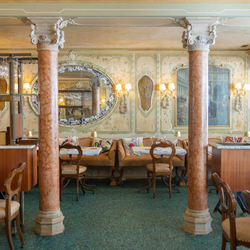
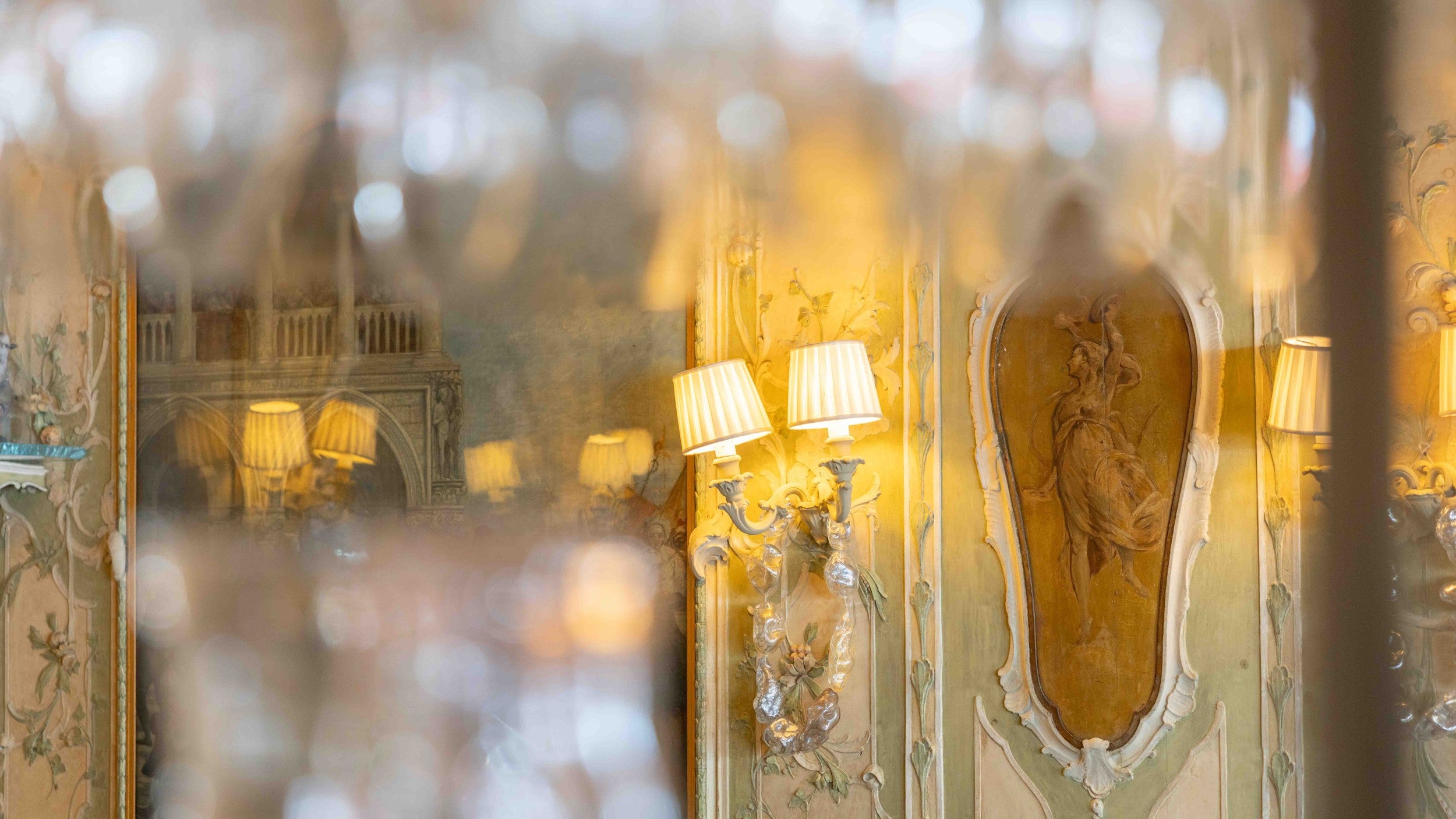
On the ground floor, in the Quadrino and Gran Caffè Quadri rooms, the restoration carried out by Anna de Spirt and Adriana Spagnol had more conservative connotations and complex implications.
The goal was to recover the decorations from the early 1900s and also from the second half of the 1900s, eliminating the layers that had accumulated over time. The scale of the work required the team to work even at night.
BEVILACQUA WEAVING
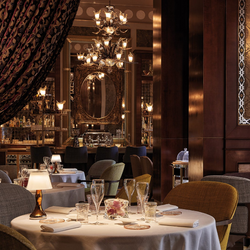
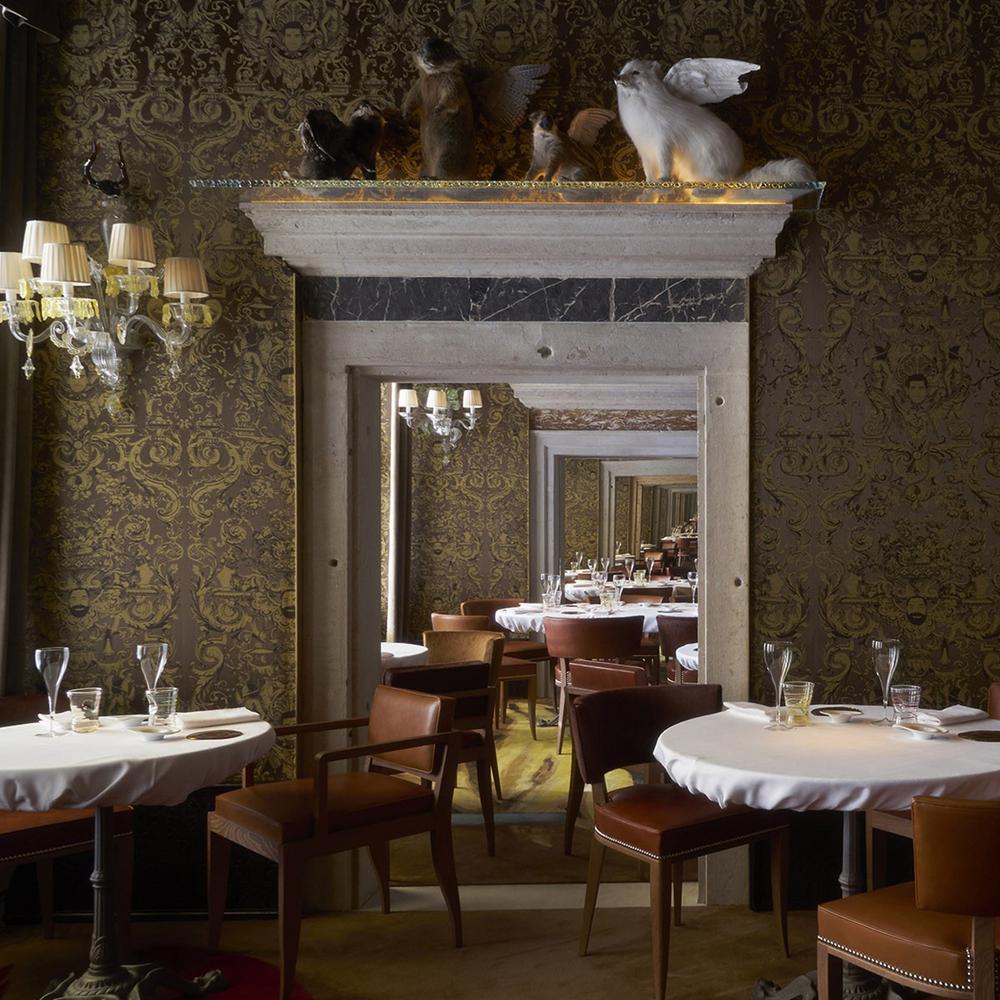
On the first floor, where the Quadri Restaurant is located, Starck's influence is evident in the decorations and the restoration of original architectural details. The first thing you notice is the fabric covering the walls, made by Tessitura Bevilacqua and redesigned by Philippe Starck, who has reinterpreted the Venetian atelier's oldest design in a contemporary key, adding humor to the idea of tradition and quality.
The faces of the period have been replaced by those of the Alajmo brothers in a repeating motif, lost and camouflaged by the grandeur of the walls. Spaceships and satellites blend in, representing modern means of transportation rather than carriages and gondolas.
Aristide Najean
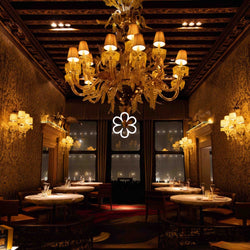
The large, fully restored Rezzonico chandelier, made of Murano glass from the 1930s, has been joined by a new chandelier that reflects the same dimensions and style with the addition of cast glass details that create a surrealist effect. The artist of the work is Aristide Najean, French but Venetian by adoption, who has been in Murano since 1985 to learn the art of glassmaking from the great master glassmakers.
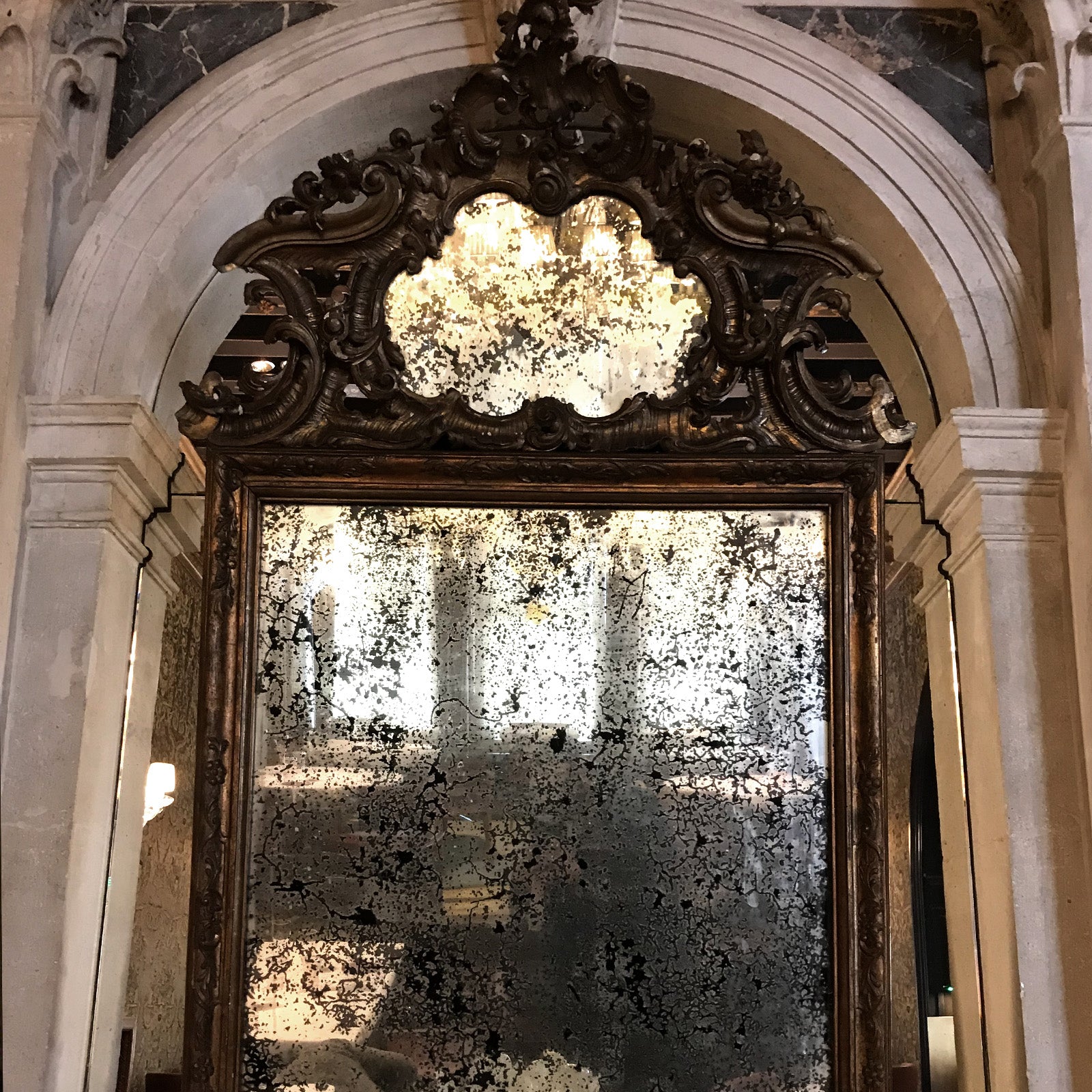
Barbini Brothers
The large mirror at the entrance and the mirrors in the bathrooms were created by the Barbini brothers, a historic family of master glassmakers in Murano since 1570. They are also responsible for the Hall of Mirrors at Versailles.
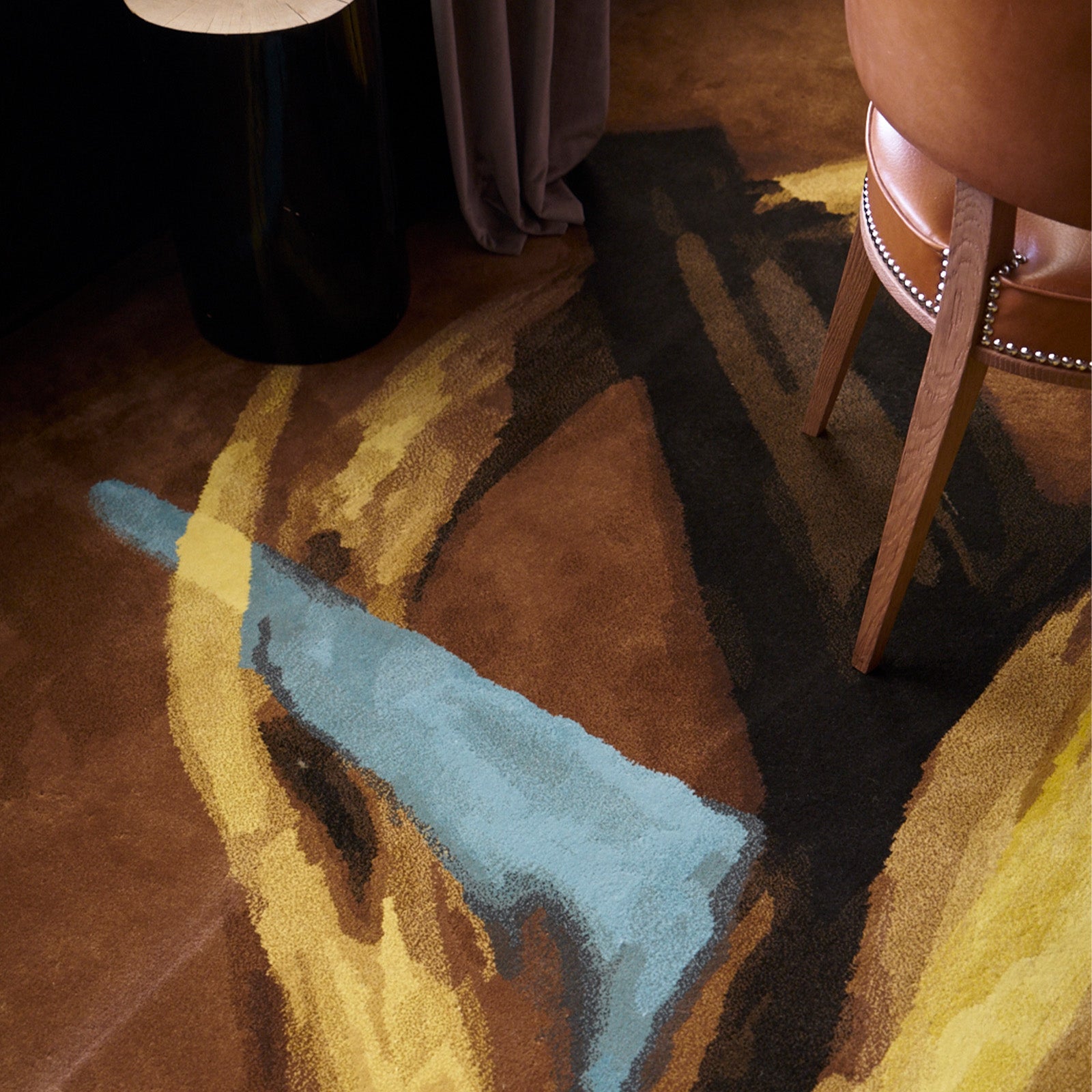
Ara Starck
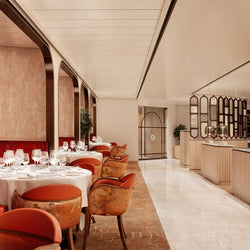
In painting the carpets that cover the floors on the first floor, Ara Starck created a complex game in which the central figures move in a phantasmagorical world as a reflection of our subconscious and an invitation to dream.
CAPOVILLA
The wooden window frames were restored by the Capovilla carpentry shop, which improved their construction details.
